Foundation Planning Guide
Why Your Foundation Choice
Matters More Than You Think
Your foundation determines the long-term durability, efficiency, and performance of your barndominium from the ground up.
The Foundation Sets Everything
For barndominium builders, the foundation isn't just a starting point — it's the base layer that influences every structural and design decision that follows.
Choosing the wrong foundation for your soil type, climate, or floor plan can create moisture problems, uneven settling, insulation issues, and expensive repairs years later.
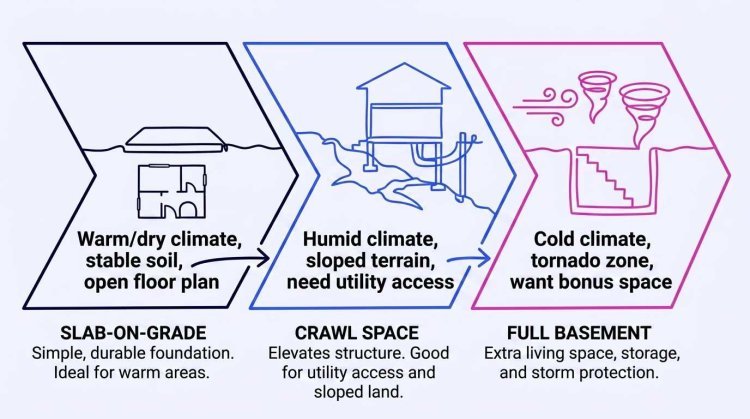
Most barndominiums are built using one of three foundation systems: slab-on-grade, crawl space, or a full basement.
Builder Insight
The best foundation is the one engineered specifically for your land conditions, regional climate, and long-term lifestyle needs.
Soil Conditions
Ground stability matters
Expansive clay, sandy, or rocky soils each respond differently to heavy structural loads and require different foundation strategies.
Climate & Frost
Regional weather impacts design
Northern states need deeper footings to prevent frost heave, while warmer southern climates often favor slab foundations.
Zoning & Codes
Regulations vary by county
Some counties and municipalities require specific foundation systems for residential structures and ADU-style barndominiums.
Crawl Space Foundation
Option 2: Crawl Space
Foundation
Crawl space foundations elevate your barndominium above the ground while creating valuable access space beneath the structure.
A crawl space foundation raises your barndominium anywhere from 18 inches to several feet off the ground using concrete or block perimeter walls. While the space beneath the home isn't designed for living, it provides critical access for utilities, insulation, maintenance, and inspections.
Utility Access
Easy access to plumbing, HVAC, and electrical systems
Future repairs and upgrades are far less invasive
No need to cut into finished floors for modifications
Climate Performance
Elevates the structure above ground moisture
Performs well in humid and flood-prone regions
Helps reduce long-term moisture-related damage
Sloped Lots
Excellent for uneven or gently sloped terrain
Avoids expensive site leveling for slab foundations
Better adaptability to challenging lot elevations
Considerations Before You Choose
Must be properly encapsulated and ventilated to prevent moisture buildup and pest intrusion
Insulation beneath floor joists is essential in colder climates
Adds some structural height — entry steps should be planned carefully
Requires periodic inspection and maintenance of the crawl space environment
Pro Tip
Encapsulated crawl spaces with a sealed vapor barrier and dehumidifier outperform vented crawl spaces in almost every US climate zone — making them well worth the upfront investment.
Full Basement Foundation
Option 3: Full Basement
Foundation
Full basements provide storm protection, additional living space, and year-round thermal efficiency for barndominium owners.
A full basement extends the foundation several feet below grade, creating a fully enclosed lower level beneath your barndominium. While less common than slab foundations, basements offer major advantages in tornado-prone and cold-climate regions where additional shelter and usable square footage are highly valuable.
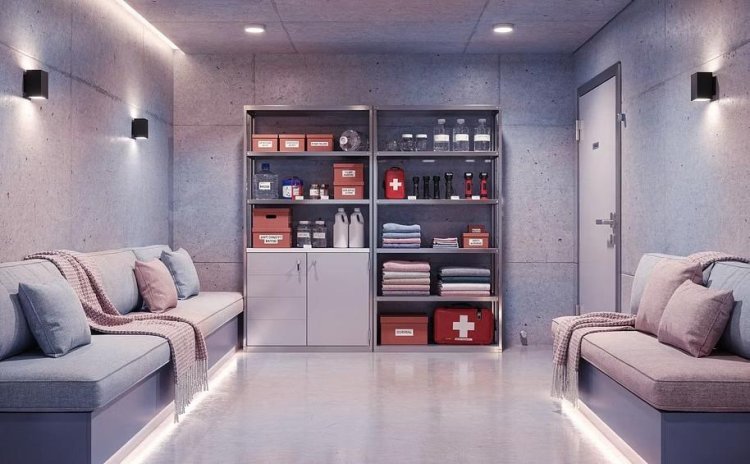
Storm Safety
In Tornado Alley states like Kansas, Nebraska, Missouri, and Iowa, basements provide reliable below-grade protection during severe storms.
For many families, storm protection alone makes a basement foundation worth the investment.

Bonus Living Space
Finished basements can become workshops, gyms, guest suites, entertainment areas, or large storage spaces.
This effectively expands your usable square footage without increasing the home's footprint.
Thermal Performance
Below-grade spaces naturally maintain stable temperatures year-round, often around 55°F.
This reduces heating and cooling demands in regions with extreme seasonal temperature swings.
Important Considerations
Basements require high-quality waterproofing and drainage systems to prevent moisture intrusion.
Egress windows are required for any habitable basement living areas under most US building codes.
High water table regions like coastal areas, Florida, and parts of Louisiana may make basement construction impractical or prohibited.
Foundation Decision Framework
How to Choose the Right
Foundation for Your Barndominium
There's no single “best” foundation — the right choice depends on land, climate, floor plan, and lifestyle.
01
Get a Soil Test
A geotechnical report reveals soil strength, drainage, and load capacity.
02
Check Local Codes
Local building rules may restrict or require specific foundation types.
03
Consult Engineer
Structural systems require engineering validation before final selection.
04
Choose Floor Plan First
Your floor plan should guide your foundation—not the opposite.