Barndominium Costs: Understanding the Investment in 2026
From affordable shell kits to luxury custom builds — here's what you need to know before you budget for your barndo.
The Barndominium Appeal: Custom Homes, Big Savings?
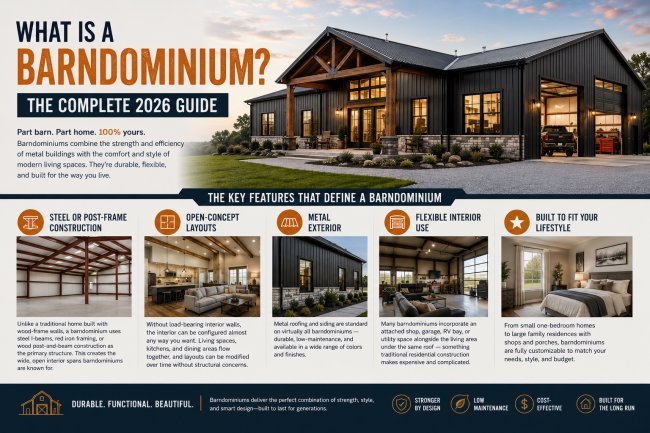
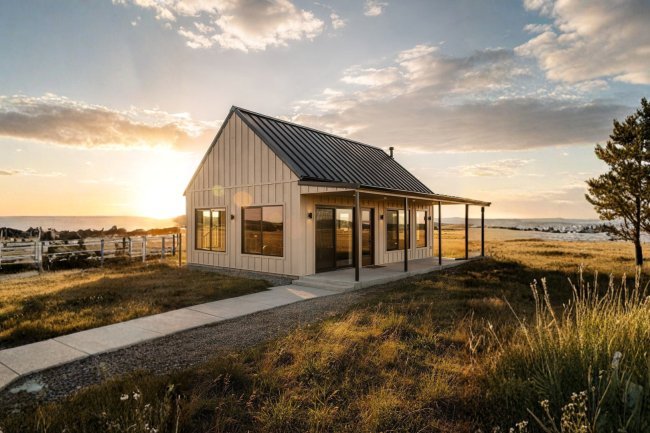
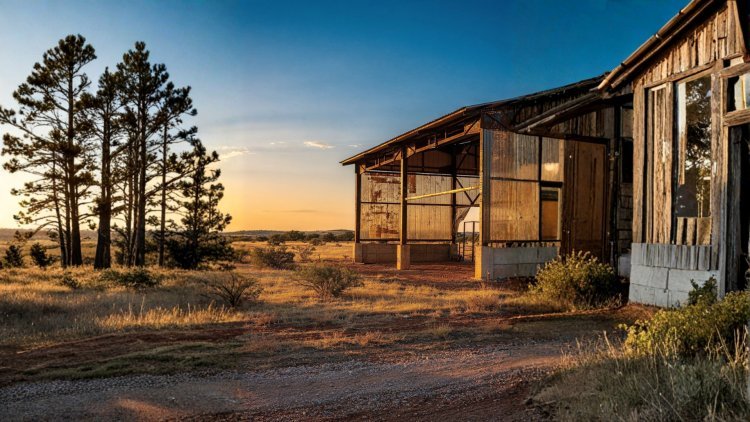
Barndominiums — affectionately known as “barndos” — have surged in popularity as a faster, more affordable path to a truly custom home. Built on a steel post-frame structure, they offer open floor plans, durability, and the flexibility to combine living space with a workshop, garage, or hobby area all under one roof.
Why Barndos Are So Appealing
With spacious layouts, strong steel framing, and the ability to blend residential and functional spaces, barndominiums offer a unique alternative to traditional custom homes. For many buyers, the appeal lies in getting more flexibility, more usable space, and potentially faster construction.
Faster Construction Timeline
Barndominiums can often be built faster than traditional stick-built homes, especially when using pre-engineered metal building systems or simplified structural layouts.
Open, Flexible Floor Plans
Because barndos typically require fewer interior load-bearing walls, they allow for wide-open layouts, vaulted interiors, and easier customization of living spaces.
Living and Working Space Combined
One of the biggest advantages is the ability to combine a home, workshop, garage, storage area, or hobby space under one roof without sacrificing design flexibility.
Durable Steel Structure
Steel framing and metal exteriors can offer strong resistance to harsh weather, pests, and long-term structural wear when properly engineered and maintained.
The Reality Check
But the idea that barndominiums are uniformly cheap can be misleading. In practice, costs can swing widely depending on the level of finishes chosen, the structural complexity of the design, and most critically — where in the country you’re building.
The Promise
- Faster construction timeline than traditional homes
- Open floor plans with fewer load-bearing walls
- Combined living and working space
- Durable steel framing for harsh conditions
The Reality
- A simple shell is only part of the total cost
- Interior build-out can rival custom homes
- High-end finishes increase the budget quickly
- Location can make or break cost per square foot
Cost Clarity Matters in 2026
In 2026, the gap between a basic shell and a high-end custom barndo is wider than ever. Understanding where your project falls on that spectrum is the first step to building an accurate and realistic budget.
National averages provide a useful starting point, but the range is broad enough that knowing which end of the spectrum applies to your project is essential. Here’s how the 2026 numbers break down at a national level.
The approximate national average for a completed barndominium in 2026, according to Angi — March 2026.
Typical finished cost range per square foot for standard builds with mid-grade finishes, according to BuildingsGuide — March 2026.
Premium turnkey builds with designer finishes, architectural exteriors, and high-end mechanicals can exceed this threshold, according to BuildingsGuide — 2026.
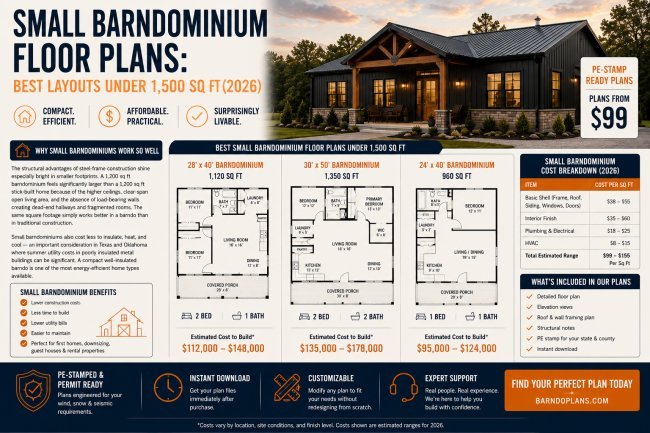
These figures underscore a critical point: “barndominium cost” is not a single number. A 2,000 sq. ft. standard barndo might come in around $130,000–$320,000 finished, while a luxury 3,000 sq. ft. build with premium details could exceed $1,000,000.
A 2,000 sq. ft. standard barndominium with mid-grade finishes may fall within this finished cost range, depending on labor, materials, and location.
A 3,000 sq. ft. high-end custom barndo with premium details, advanced mechanical systems, and designer finishes could exceed $1,000,000.
The national average of approximately $230,000 represents a mid-range finished home — not a shell, and not a luxury custom build. It should be used as a broad benchmark rather than a precise estimate for every project.
All figures represent finished, move-in ready barndominiums unless otherwise noted. Shell-only and materials-only prices are significantly lower and should not be compared directly to finished cost estimates.
National Cost Averages: A Wide Spectrum
$230K
Average Total Cost
$65–$160
Per Sq. Ft. — Standard
$350+
Per Sq. Ft. — Luxury
Cost Is Not a Single Number
Standard Build Example
Luxury Build Example
What the National Average Really Means
Important Pricing Note
When you see barndominium cost estimates ranging from $65 to $350+ per square foot, the natural question is: why such a massive spread? The answer lies in four primary variables that interact with each other and compound significantly depending on the project.
Barndominium pricing depends on more than square footage. Region, finishes, design complexity, and overall project size work together to create major cost differences from one build to another.
Key Cost Drivers: Why Estimates Vary So Much
Why the Range Is So Wide
The most common source of sticker shock in barndominium budgeting comes from confusing the cost of a materials-only shell kit with the cost of a finished, livable home. These are two completely different products separated by tens — sometimes hundreds — of thousands of dollars worth of labor and materials.
Never compare a shell kit price to a finished home estimate. They represent completely different scopes of work and should never be used interchangeably when budgeting.
Shell vs. Finished: The Biggest Misconception
Never Compare Shell Kit Pricing to Finished Home Pricing
Armed with an understanding of cost drivers and the shell vs. finished distinction, here’s how a realistic 2026 barndominium budget breaks down by build tier. These ranges assume a finished, move-in ready home and include typical contractor labor, standard site conditions, and average regional pricing.
Realistic Expectations for 2026 Builds
What's Your Reaction?